The growing popularity and practicality of electric bicycles, weighing their ability to transform daily travel against potential downsides. These motorised bikes are highlighted as efficient tools for long-distance commuting and hauling heavy cargo, often featuring integrated technology like safety lighting and digital displays for a modern riding experience. While they offer high speeds and pedal-assisted workouts, the author notes significant concerns regarding their high retail cost, heavy frame weight, and susceptibility to theft. To mitigate these issues, advanced models now include features such as removable batteries and torque sensors that provide a more natural cycling sensation.
The way an e-bike handles and assists you depends significantly on its classification and the type of sensor it uses to engage the motor.
How do different e-bike classes and sensors affect my ride?
E-bike Classes
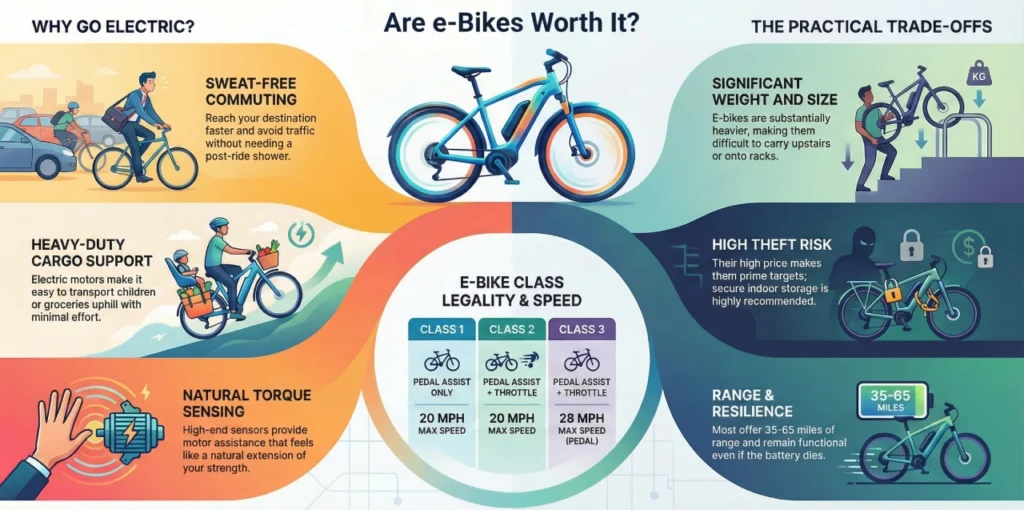
E-bikes are generally categorised into three classes, which dictate how much assistance you receive and how fast you can go:
- Class 1: This provides pedal assist only up to 20 mph. The motor only works when you are actively pedalling.
- Class 2: This also provides assistance up to 20 mph but includes a throttle. This means you can move at top speed without needing to pedal at all, which is ideal if you want to commute to work without becoming sweaty.
- Class 3: These bikes allow for throttle use up to 20 mph, but offer pedal assist up to 28 mph. This class is useful for getting to destinations very quickly, though the higher speeds are more dangerous and subject to stricter local laws and trail regulations.
Sensors and Ride Feel
The sensor technology determines how the motor responds to your movement, which fundamentally changes the riding experience:
- Cadence Sensors: Typically found on budget-friendly models, these sensors simply detect if you are pedalling. Once movement is detected, the motor engages. This often feels as though the bike is “taking over,” which can make it harder to get a meaningful workout because the motor does most of the work regardless of your effort.
- Torque Sensors: These sensors measure how hard you are pedalling and provide motor assistance proportionally. This creates a much more natural ride feel, often described as feeling like you have “massive quads”. Because the motor responds to your actual exertion, you can still get a serious workout while travelling further and faster than on a traditional bike.
Impact on Your Ride
Choosing between these options depends on your goals. If your priority is a non-strenuous commute, a Class 2 or 3 bike with a throttle allows you to avoid physical exertion. However, if you want the e-bike to supplement a fitness routine, a bike with a torque sensor is superior because it requires you to put in effort to receive more power back from the motor.
Additionally, higher-speed Class 3 bikes may be prohibited on certain trails for safety reasons, so your choice of class also affects where you are legally allowed to ride. Some modern e-bikes, like the Aventon Level.2, allow you to adjust speed limits via an app to match your comfort level or local regulations.
How do removable batteries help manage charging and theft risks?
Removable batteries are a key feature for managing the logistical challenges of owning an e-bike, particularly concerning their weight and high value.
Managing Charging Risks and Logistics
One of the primary difficulties with e-bikes is that they are substantially heavier than traditional bicycles, making them difficult to carry up stairs or into buildings. Removable batteries help manage this by:
- Improving Portability: Instead of struggling to bring a “heavy, chunky” bike into an apartment or office, you can simply unlock the battery and carry it inside on its own.
- Convenient Charging Locations: Because the battery is portable, you can charge it in convenient locations, such as under your desk at work or in your home, while leaving the bike frame in a secure parking area or garage.
- Use of Spare Batteries: A removable system allows you to use spare batteries. For example, you can keep one battery charging at home and another at work, allowing you to swap them out to extend your range without waiting for a single unit to recharge.
Mitigating Theft Risks
Because e-bikes are expensive, they are frequent targets for theft, and their weight often forces owners to lock them outside in plain sight. Removable batteries offer specific security advantages:
- Protecting High-Value Components: Even if you are forced to lock the bike frame outside, taking the battery with you ensures that this critical and expensive component cannot be stolen.
- Keyed Security: Many models, such as the Aventon Level.2, feature batteries that are locked in place with a key. This prevents someone from simply walking away with the battery while the bike is parked.
- Theft Deterrence: A bike without its battery is significantly less functional and potentially less attractive to thieves, as the battery is one of the most vital parts of the e-bike system.
What are the practical pros and cons of e-bike commuting?
Commuting by e-bike offers a range of practical advantages, particularly for urban environments, though it also introduces specific logistical challenges regarding weight and security.
Practical Pros of E-bike Commuting
- Efficiency and Speed: E-bikes make long-distance travel much more practical; for instance, they can turn a 14-mile trek into a manageable daily routine. Because you can travel at higher speeds (up to 28 mph on Class 3 bikes) and use bike lanes or trails, you can often avoid traffic congestion and the hassle of finding or paying for parking in busy cities.
- Professional Appearance: Unlike traditional cycling, using a Class 2 or Class 3 e-bike with a throttle allows you to arrive at your destination without being sweaty, as you can rely on the motor rather than physical exertion.
- Cargo and Hills: The motor assistance makes it significantly easier to tackle steep hills and carry heavy cargo, such as groceries or a child in a rear seat. Some e-bikes are even designed with front cabins to transport multiple children.
- Integrated Technology: Most e-bikes come with built-in accessories powered by the main battery, including bright headlights and tail lights for safer night riding, and on-board computers that track speed and distance.
- Commuter Convenience: Many models feature removable batteries that lock into place. This allows you to leave the heavy bike frame in a secure area while taking the battery inside to charge under your desk at work. Additionally, a “walking assist” mode can help you move the bike up steep inclines if you need to dismount.
Practical Cons of E-bike Commuting
- Weight and Portability: E-bikes are substantially heavier than traditional bicycles due to the motor and battery. This makes them difficult to lift onto car racks or carry up stairs, which is a significant drawback for those living in upper-floor apartments.
- Theft Risk and Storage: Because e-bikes are expensive, they are high-value targets for thieves. Their weight makes them hard to bring indoors, increasing the likelihood that they will be left outside where they are more vulnerable, even with high-quality locks.
- Safety and Regulations: Travelling at speeds of up to 28 mph is inherently more dangerous than casual cycling, requiring more focus on protective gear and the safety of others on crowded trails. Furthermore, legal regulations vary by state, and some local trails may prohibit e-bikes entirely.
- Battery Dependency: While an e-bike still functions if the battery dies, it becomes a heavy regular bike with more resistance, making it harder to pedal than a standard bicycle.
- High Initial Cost: Compared to a used traditional bike, e-bikes represent a much larger financial investment, which may not suit every budget.